 Deckline Decks
 Composite Decks
Composite is the low-maintenance deck built for the coast: no oiling, no rot, and it shrugs off the salt and the weather. We lay genuine named composite by Trex, Modwood or Ekodeck, the board on your quote so you know the colour and the warranty, on a sub-frame built to suit it, often with joists closer together than timber. A premium board on a cheap frame still sags, so the substructure is where we do not cut corners.
What this job includes.
- ✓Genuine Trex, Modwood and Ekodeck composite decks
- ✓The board and colour named on the quote, never an unbranded look-alike
- ✓Sub-frame built to suit the board, joists closer together where needed
- ✓Hidden-fixed boards for a clean, fastener-free top
- ✓Colour and shade advice for a deck that stays comfortable underfoot
Composite is a brand decision before it is a price decision
Composite is not one product. Trex Transcend, Modwood Natural Grain and Ekodeck Designer Series are three different boards from three different mills, with three different warranties and three different prices per linear metre. A cheap operator quotes “composite” and lets the homeowner assume the premium board. We name the brand, the range and the colour on every quote. The line on our quote matches the line on the supplier’s invoice, and the manufacturer warranty (25 years stain and fade on Trex Transcend, 25 years on Modwood, 10 to 15 years on the value ranges) is registered to your address at handover.
What changes when you go composite
The boards cost more, but the substructure changes too. Composite needs joists at 400 to 450 mm centres rather than the 600 mm centres a hardwood deck can run on, because composite has more flex over a span. The fixings change as well: hidden clips, screwed through the joist, with the right side of the board exposed. Lay it on a hardwood-grade substructure and the deck waves within a year. We price the correct sub-frame for the named board, not the cheaper one underneath it, and the quote shows both lines.
What an itemised composite deck includes
- The area in m², the brand, the range and the colour, each named
- The substructure built for the board: footing depth, post size, joist spacing at the spec
- Ledger board and flashing where the deck meets the house
- Balustrade to the NCC if the deck is over a metre up (composite-faced or matching timber)
- Stainless or hot-dip galvanised fixings, the grade named for coastal blocks
- Hidden-clip fixing where the board allows, screw-through where it does not
- The manufacturer materials warranty registered to your address at handover
- A 10-year warranty on footings, bearers and posts, in writing
We do not oil composite (it does not need it). What it does need is the right sub-frame and the right fixings underneath it. That is where the price between two composite quotes splits, line by line.
Priced by the m², itemised line by line.
The area in m² and the board and grade named, the footing depth and the bearer and joist spacing, the posts, the ledger flashing where the deck meets the house, the balustrade to the NCC, the stairs and any council approval. Not one round number for a deck.
- 1 Area in m², board and grade named. The price set by the m², with the board and its grade named: merbau or spotted gum, the composite brand, or H3 and H4 treated pine. Not one round number for "the deck".
- 2 The substructure, in full. The footing depth, the bearer and joist spacing, and the posts, sized for the height and the ground. This is the hidden frame that holds the deck up, and the line cowboys skip.
- 3 Ledger board and flashing to the house. Where the deck bolts to the house, the ledger board and its flashing, stated and detailed, because that join is what keeps water out of your wall.
- 4 Balustrade spec to the NCC. If the deck is over a metre up, the balustrade named to the NCC: timber, metal or glass, at least a metre high with gaps under 125 mm, so it passes rather than gets pulled up.
- 5 Stairs. Any stairs their own line: the rise, the run and the landing, built and balustraded to suit the height, not folded into a round number.
- 6 Council approval or CDC note. A plain note on which approval path the deck falls under, exempt, a Complying Development Certificate or a DA, so you know before we build, not after.
- 7 Warranty and finish. The 10-year footings, bearers and posts warranty in writing, the composite manufacturer warranty or the timber oil and coating, and how the finish is handled.
What happens, step by step.
Site measure and set-out
We measure the space, check the ground, the falls and the height, talk through board and balustrade, mark the set-out, then put a written by-the-m² quote in your hands.
Footings and posts
We dig and concrete the footings to depth, sized for the height and the ground, and set the posts plumb. The footings cure before any load goes on them. This is the substructure that holds the deck up.
Bearers and joists
The bearers and joists go on at the correct spacing for the board, closer together for composite, so the deck stays flat and never bounces. The frame is the deck; the boards are the finish.
Ledger and flashing
Where the deck meets the house we fix and flash the ledger board properly, so the join carries the load and keeps water out of your wall instead of bolting straight on.
Boards down
The boards go down at the right gap for drainage, screwed or hidden-fixed to the joists, raked and trimmed clean. Merbau, treated pine or the named composite, exactly as quoted.
Balustrade, stairs, oil and handover
We build the balustrade to the NCC and the stairs to suit the height, oil or finish the timber, clear the site, walk you around, and hand over the warranty and any compliance paperwork in writing.
The paperwork behind the price.
Public liability to $20M, and a 10-yr substructure warranty, all in writing, all on request.
Every deck is priced by the m², with the board and its grade named on the quote, the merbau or spotted gum, the composite brand, or H3 and H4 treated pine, and the substructure itemised: the footing depth, the bearer and joist spacing, the posts, and the ledger flashing where the deck meets the house. Any balustrade is built and named to the NCC. We hold a NSW Fair Trading building licence (000000C) and carry public liability insurance to $20M, and the guarantee is a 10-year written warranty on the footings, bearers and posts, the part that holds the deck up and the part cowboys skimp, plus the genuine composite manufacturer materials warranty where the boards are Trex, Modwood or Ekodeck. Deckline Decks is a composite reference site, so the licence number, ABN and contact details are illustrative placeholders, not a real operator; on a live build these are the real, verifiable credentials of the business.
Composite Decks jobs we’ve done.
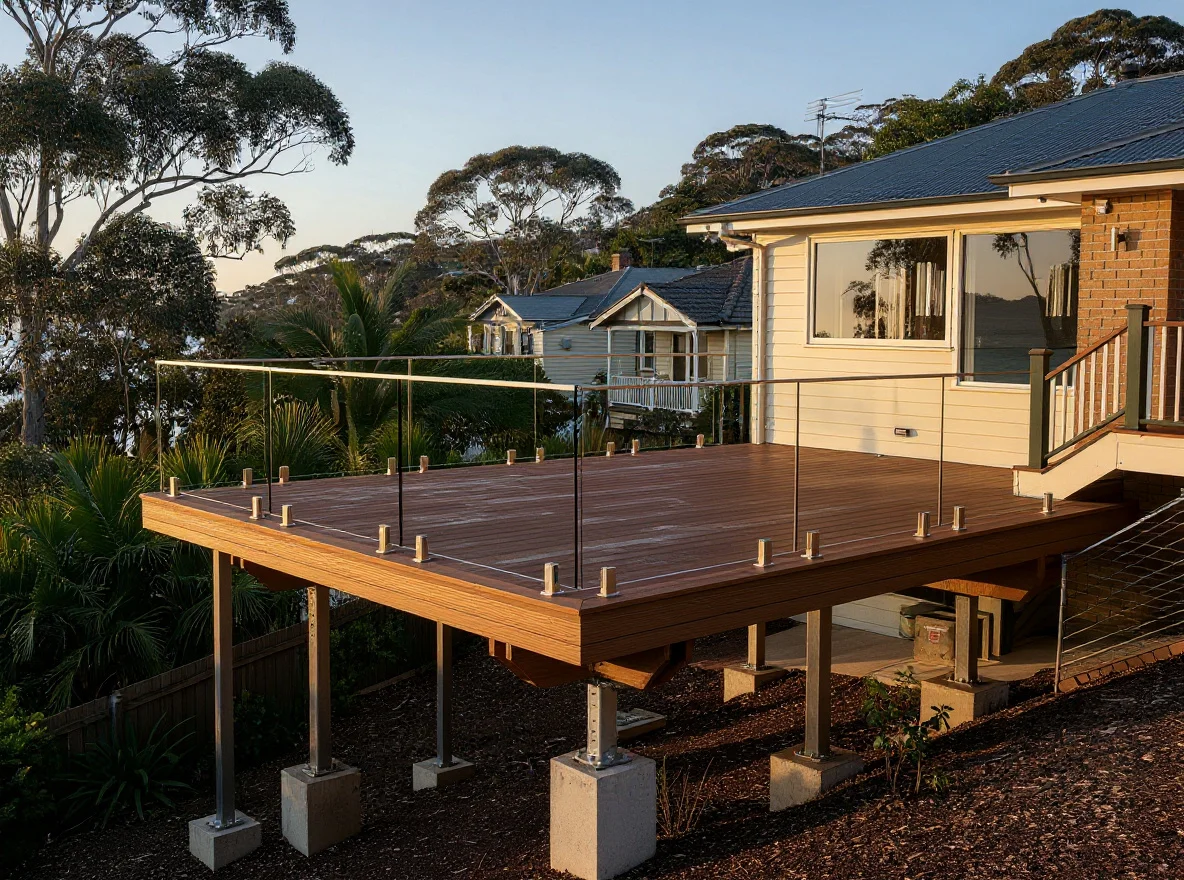 Before
 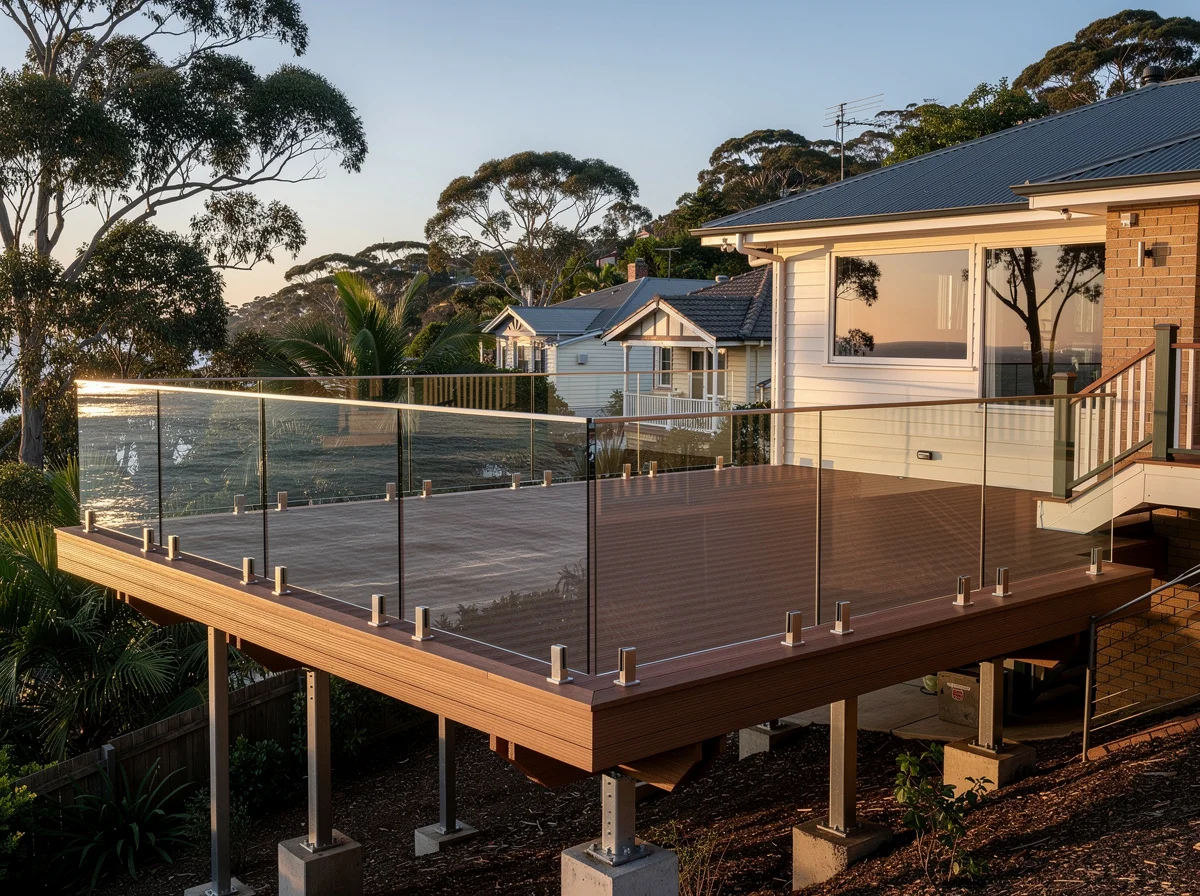 After
After Composite Decks: common questions.
Is it genuine Trex, Modwood or Ekodeck, or a look-alike?
Does composite get too hot to walk on in summer?
Do I still need a good sub-frame under composite?
Is composite worth the extra over hardwood near the coast?
Get a free, itemised quote you can actually read.
Tell us what you need. We’ll book a walkthrough and send a quote with the work itemised, not just a number.